Home › Metabolic › Cagrilintide (10mg)
Metabolic Research Peptide
Cagrilintide (10mg)
Long-acting amylin analogue · AMY/CT receptor agonist · Research-grade, Australia
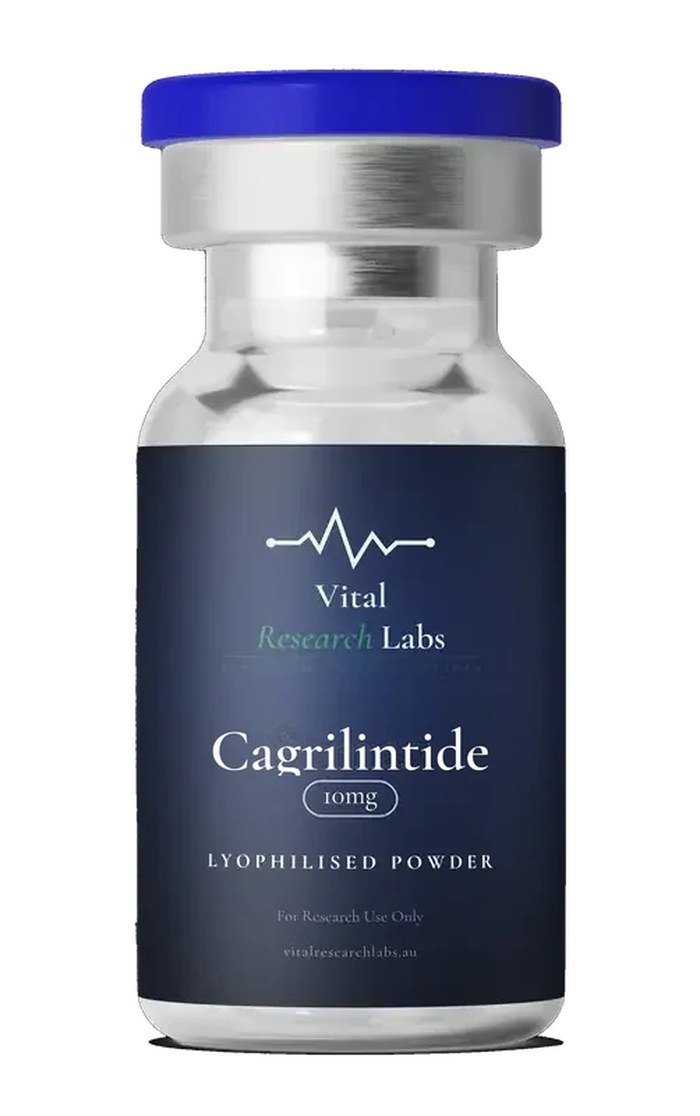
In stock · dispatched Australia-wide
View & buy on store →About Cagrilintide
Cagrilintide (development code AM833) is a long-acting synthetic analogue of amylin, a peptide hormone co-secreted with insulin by pancreatic beta cells. It is acylated at the N-terminus with a C20 fatty diacid linked via a γ-glutamic acid spacer, and carries an intramolecular disulfide bond between Cys3 and Cys8 — structural modifications that extend its half-life and reduce fibril formation relative to native amylin.
Within the research community, Cagrilintide has drawn interest as a subject for studying amylin and calcitonin receptor signalling, energy homeostasis, and satiety pathways in pre-clinical and laboratory models — including alongside GLP-1 receptor agonists. It is supplied by Vital Research Labs strictly as a reference compound for in-vitro laboratory investigation.
Receptor targets
Cagrilintide is characterised in research as a non-selective agonist across two related receptor systems:
- Amylin receptors (AMYR) — studied in relation to satiety signalling and energy balance.
- Calcitonin receptor (CTR) — a related class B GPCR studied alongside amylin signalling.
Molecular & physical profile
| Compound | Cagrilintide |
|---|---|
| Synonyms | AM833, NN0174-0833 |
| Category | Metabolic |
| CAS Number | 1415456-99-3 |
| Molecular formula | C194H312N54O59S2 |
| Molecular weight | 4409.01 g/mol |
| Length | 37 amino acids |
| Modification | N-terminal C20 fatty diacid acylation; Cys3–Cys8 disulfide |
| Form | Lyophilised powder |
| Appearance | White to off-white solid |
| Quantity | 10 mg per vial |
| Purity | 99.845% (this batch) |
| Batch | CS-cag10-2223 |
| Analytical methods | HPLC (purity), mass spectrometry (identity) |
| Solubility (research) | Reconstitutes in bacteriostatic or sterile water |
Batch-specific analytical values are recorded on the Certificate of Analysis supplied with this batch.
Reconstitution & handling
Cagrilintide is supplied as a lyophilised (freeze-dried) powder. For research handling it is typically reconstituted with bacteriostatic water; the exact volume depends on the concentration a given research protocol calls for. Handle under appropriate laboratory conditions and avoid repeated freeze–thaw cycles of the reconstituted solution.
Storage & stability
- Lyophilised powder — store at -20 °C, protected from light and moisture.
- Reconstituted solution — store at 2–8 °C and use within 28 days.
- Handling — minimise freeze–thaw cycles; keep vials sealed until use.
Quality & testing
Every batch supplied by Vital Research Labs is analysed by an independent third-party laboratory. Purity is confirmed by high-performance liquid chromatography (HPLC) and identity by mass spectrometry (MS). The Certificate of Analysis for this batch is published in our CoA library once received.
Shipping within Australia
Cagrilintide is dispatched from within Australia to Australian research customers, packaged discreetly and appropriately for a lyophilised research compound. Orders are processed on receipt of payment via bank transfer.
Frequently asked questions
Is Cagrilintide available in Australia for research?
Yes. Vital Research Labs supplies research-grade Cagrilintide (10mg) to Australian research customers, dispatched domestically. It is provided strictly for in-vitro laboratory research and is not for human or veterinary use.
What purity is your Cagrilintide?
This batch is verified at 99.845% purity by third-party analytical testing (HPLC for purity, mass spectrometry for identity). The Certificate of Analysis for batch CS-cag10-2223 is published in our CoA library.
How is Cagrilintide tested?
Each batch is analysed by an independent third-party laboratory using HPLC to confirm purity and mass spectrometry to confirm identity. Batch-specific values are recorded on the Certificate of Analysis once testing is complete.
How should Cagrilintide be stored?
The lyophilised powder is stored at -20 degrees C, protected from light and moisture. Once reconstituted for research it is kept at 2-8 degrees C and typically used within 28 days. Avoid repeated freeze-thaw cycles.
How does Cagrilintide differ from native amylin?
Cagrilintide is acylated with a C20 fatty diacid via a gamma-glutamic acid spacer and carries a Cys3-Cys8 disulfide bond. In research models these modifications extend its duration of action and reduce the tendency to form amyloid fibrils compared with native amylin.
Is Cagrilintide intended for human use?
No. Cagrilintide (10mg) supplied by Vital Research Labs is intended strictly for in-vitro laboratory research and development. It is not a medicine or therapeutic good and is not for human consumption, veterinary use, or clinical application.
Where can I buy Cagrilintide in Australia?
Vital Research Labs supplies Cagrilintide from Australian stock, dispatched from New South Wales. Orders placed before the daily cut-off are dispatched the same business day, Monday to Friday, with tracked delivery Australia-wide including Sydney, Melbourne, Brisbane, Perth and Adelaide.
How long does delivery take?
Orders are dispatched the same business day payment is confirmed, Monday to Friday. Weekend and public holiday orders are dispatched the next business day. Standard and express options are available, and express shipping is free on orders over $200. Every order is sent tracked.
Is packaging discreet?
Yes. All orders are packed in plain, unbranded outer packaging with no indication of the contents, and sent tracked via Australia Post or an equivalent carrier.
What payment methods do you accept?
We accept bank transfer. After placing your order you'll receive our account details and a unique payment reference by email — include that reference so we can match your payment. Orders are dispatched as soon as payment clears.