Home › Metabolic › Retatrutide (30mg)
Metabolic Research Peptide
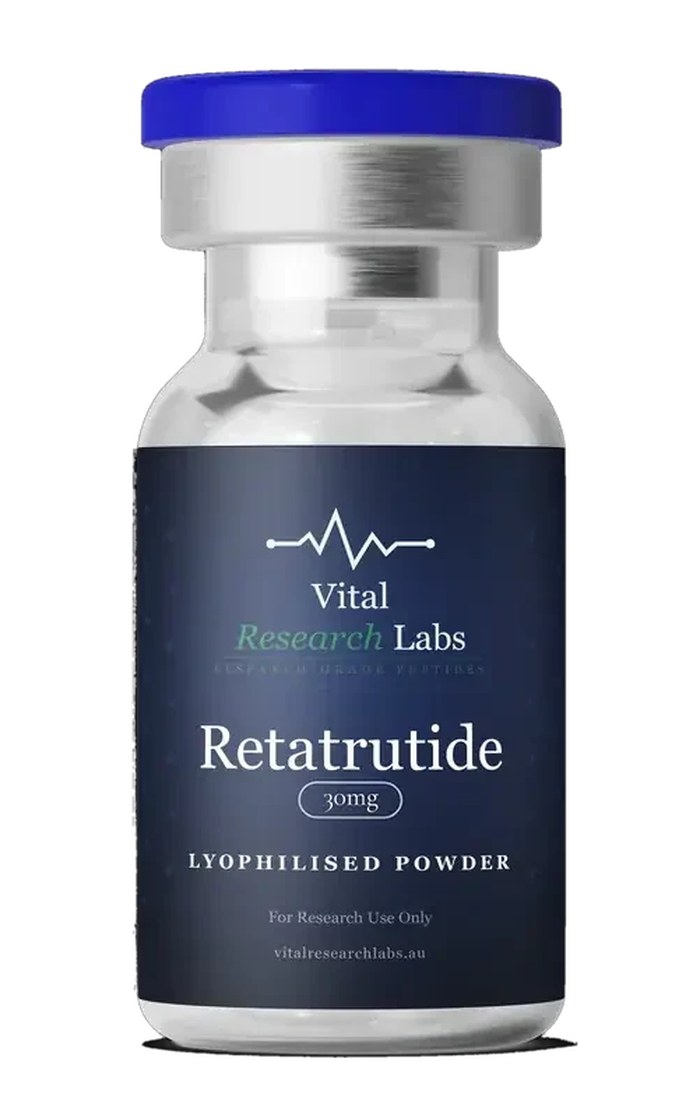
Retatrutide (30mg)
GLP-1 / GIP / Glucagon triple-receptor agonist · Research-grade, Australia
In stock · dispatched Australia-wide
View & buy on store →About Retatrutide
Retatrutide (development code LY3437943) is a synthetic triple-agonist peptide that acts on three metabolic receptor targets at once: the glucagon-like peptide-1 (GLP-1) receptor, the glucose-dependent insulinotropic polypeptide (GIP) receptor, and the glucagon receptor. This 30 mg presentation is the largest we offer, intended for extended laboratory study protocols.
The 30 mg presentation is aimed at longitudinal work — study designs where the same compound lot needs to be available at intervals over weeks or months rather than consumed in a single block. Because a Certificate of Analysis is tied to a lot, a study that spans several months on one 30 mg fill can report a single purity figure for its entire duration. Restocking mid-study introduces a second lot and, with it, a second purity value that has to be accounted for when the data are analysed.
Receptor targets
- GLP-1 receptor — a target widely studied in incretin and glucose-regulation research.
- GIP receptor — an incretin receptor investigated alongside GLP-1 in metabolic-pathway studies.
- Glucagon receptor — a target studied in relation to energy expenditure and hepatic metabolism.
Molecular & physical profile
| Compound | Retatrutide |
|---|---|
| Synonym | LY3437943 |
| Category | Metabolic |
| CAS Number | 2381089-83-2 |
| Form | Lyophilised powder |
| Appearance | White to off-white solid |
| Quantity | 30 mg per vial |
| Purity | 99.670% (this batch) |
| Batch | CS-re30114 |
| Analytical methods | HPLC (purity), mass spectrometry (identity) |
| Solubility (research) | Reconstitutes in bacteriostatic or sterile water |
Batch-specific analytical values are recorded on the Certificate of Analysis supplied with this batch.
Reconstitution & handling
Retatrutide is supplied as a lyophilised powder for reconstitution in bacteriostatic or sterile water. A 30 mg fill is generally not reconstituted whole: the 28-day post-reconstitution window applies from the moment diluent is added, so the usual approach is to reconstitute the full vial, aliquot immediately, and freeze — drawing single aliquots as the study timeline requires. Volumes of 1.5 mL, 3 mL and 6 mL give round stock concentrations.
Stock concentrations from a single 30 mg vial:
| 1.5 mL of diluent | 20 mg/mL stock |
|---|---|
| 3 mL of diluent | 10 mg/mL stock |
| 6 mL of diluent | 5 mg/mL stock |
| 7.5 mL of diluent | 4 mg/mL stock |
In-vitro stock concentrations for laboratory dilution work. Not dosing information.
Storage & stability
- Lyophilised powder — store at -20 °C, protected from light and moisture.
- Reconstituted solution — store at 2–8 °C and use within 28 days.
- Handling — minimise freeze–thaw cycles; keep vials sealed until use.
- Aliquoting — essential at this fill weight. Reconstitute, aliquot to single-use volumes and freeze in one operation; the parent vial should not be thawed and refrozen across a long study.
Why 30mg rather than 20mg or 40mg
All four retatrutide presentations are the same compound at different fill weights, so the question is only ever which fill matches the study. The 20 mg vial covers a multi-arm design run as a single block of work. This 30 mg vial covers the same design stretched over a longer calendar — the extra material is there so the study does not have to restock, and therefore does not have to reconcile two purity figures, part-way through. The 40 mg vial goes further again and is oriented to replicate count rather than duration.
If a single characterisation run is all that is planned, the 10 mg vial is the sensible starting point — a larger fill offers nothing to a study that cannot use it inside the post-reconstitution window.
Quality & testing
Every batch supplied by Vital Research Labs is analysed by an independent third-party laboratory. Purity is confirmed by high-performance liquid chromatography (HPLC) and identity by mass spectrometry (MS). The Certificate of Analysis for this batch is published in our CoA library once received.
Shipping within Australia
Retatrutide is dispatched from within Australia to Australian research customers, packaged discreetly and appropriately for a lyophilised research compound. Orders are processed on receipt of payment via bank transfer.
Frequently asked questions
Is Retatrutide available in Australia for research?
Yes. Vital Research Labs supplies research-grade Retatrutide (30mg) to Australian research customers, dispatched domestically. It is provided strictly for in-vitro laboratory research and is not for human or veterinary use.
What purity is your Retatrutide?
This batch is verified at 99.670% purity by third-party analytical testing (HPLC for purity, mass spectrometry for identity). The Certificate of Analysis for batch CS-re30114 is published in our CoA library.
How is Retatrutide tested?
Each batch is analysed by an independent third-party laboratory using HPLC to confirm purity and mass spectrometry to confirm identity. Batch-specific values are recorded on the Certificate of Analysis once testing is complete.
How should Retatrutide be stored?
The lyophilised powder is stored at -20 degrees C, protected from light and moisture. Once reconstituted for research it is kept at 2-8 degrees C and typically used within 28 days.
What is the difference between the 10mg, 20mg, 30mg and 40mg vials?
The compound is identical; only the quantity of lyophilised powder per vial differs. The 30mg presentation is intended for extended research protocols requiring more material, and offers a lower cost per milligram than the smaller presentations.
Is Retatrutide intended for human use?
No. Retatrutide (30mg) supplied by Vital Research Labs is intended strictly for in-vitro laboratory research and development. It is not a medicine or therapeutic good and is not for human consumption, veterinary use, or clinical application.
Where can I buy Retatrutide in Australia?
Vital Research Labs supplies Retatrutide from Australian stock, dispatched from New South Wales. Orders placed before the daily cut-off are dispatched the same business day, Monday to Friday, with tracked delivery Australia-wide including Sydney, Melbourne, Brisbane, Perth and Adelaide.
How long does delivery take?
Orders are dispatched the same business day payment is confirmed, Monday to Friday. Weekend and public holiday orders are dispatched the next business day. Standard and express options are available, and express shipping is free on orders over $200. Every order is sent tracked.
Is packaging discreet?
Yes. All orders are packed in plain, unbranded outer packaging with no indication of the contents, and sent tracked via Australia Post or an equivalent carrier.
What payment methods do you accept?
We accept bank transfer. After placing your order you'll receive our account details and a unique payment reference by email — include that reference so we can match your payment. Orders are dispatched as soon as payment clears.
What stock concentrations can a 30mg retatrutide vial be reconstituted to?
Reconstituting 30mg in 1.5mL of bacteriostatic water gives 20mg/mL; 3mL gives 10mg/mL; 6mL gives 5mg/mL; and 7.5mL gives 4mg/mL. These are in-vitro stock concentrations for laboratory dilution work only.
Why would a study need a 30mg retatrutide vial?
Mainly for duration rather than volume. A Certificate of Analysis is tied to one lot, so a study running over weeks or months on a single 30mg fill can report one purity figure throughout. Restocking mid-study introduces a second lot and a second purity value to account for in the analysis.
Should a 30mg vial be reconstituted all at once?
The full vial is normally reconstituted, aliquoted to single-use volumes and frozen in one operation, because the 28-day window runs from when diluent is added rather than from first use. Thawing and refreezing a parent vial repeatedly across a long study is the outcome to avoid.